Five Notebooks Later: Lessons from an Unfolding Career
My career path has never ceased to amaze me. Looking back, it has taken twists and turns that I can only describe with awe: a little more determination, a dose of self-confidence, and people willing to take a risk and place you right in the deep end. That combination can be all one needs in a world with such short supply of opportunities, especially for women and girls.
As I move to my next station, as Executive Director of the African Forum and Network on Debt and Development (AFRODAD), I find myself looking back at the road that brought me here, and at the people who bet on me long before I had proof I was worth the bet.
Where It Started
My journey in the civic space started years ago with a phone call that has shaped me to this day. I was finalising my Master’s dissertation when I was asked to submit my CV to the Zimbabwe Coalition on Debt and Development (ZIMCODD), which was looking for a Southern Region Programme Officer. I had never held a full time job. Two internships and a few volunteer stints made up my entire experience.
The call came on a weekend, while I was in the library. It was Joy Mabenge. We had never met. He told me he had passed through the office, found a few CVs in his in tray, and mine had caught his eye, particularly my dissertation on international financial institutions and the impact of their prescriptions on Africa. He said I would be reached out to for an interview.
Sure enough, when the week started, the call came. I showed up terrified, having never been in an interview before. The panel was meant to be three people: the board chair, the vice chair, and Executive Director Joy Mabenge. But the vice chair sent a last minute apology, so Joy and Sekuru Jonah Gokova interviewed me alone. Honestly, I don’t remember what I said. I know they asked questions, I know I answered, but I couldn’t tell you if any of it made sense. What I do know is that I got the response that same day, and the next morning I was on a bus to Bulawayo, my new office station, to start my first job.
Leading ZIMCODD
A few years later, I was promoted to Programmes Director and relocated to Harare. It was a short stint. Soon after, Patricia Kasiamhuru, my Executive Director at the time, began speaking of her eventual retirement. I wasn’t sure I was ready for what came next. But when the advert for ZIMCODD’s Executive Director role went out, my boss encouraged a colleague and me to apply. We were both interviewed, and I got it. From what I later heard, the Board’s recruitment committee took a real risk in putting me on that pedestal. At 33, I was head of one of the biggest coalitions in Zimbabwe, at a difficult time for NGOs, let alone coalitions working in economic justice.
The years that followed were the hardest and the most productive of my working life. We went to court over public debt transparency, and we won, on the principle that citizens are entitled to know what is borrowed in their name. I conceptualised and authored Zimbabwe’s Sustainable Debt Management Framework, which gave the debt justice movement a technical proposal to put on the table rather than a critique alone. We sat across from creditors in Europe and from African development finance institutions and argued Zimbabwe’s case directly. Supporters showed up throughout, affirmed the work and pushed it forward. Then it was time to move on.
Leaving at the Peak
Southern Africa Trust was just operationalising SERITI when I got a message from Masego Madzwamuse about an opportunity. We spoke about leadership and pathways for growth, and I applied. What I was certain of was this: I had served ZIMCODD well, and I wanted to leave while it was still at its peak, before it had started to fade.
The interview process was gruelling, because the Trust has layer upon layer built into its recruitment. But the positive email came, and I took up the challenge to lead as Country Manager and Economic Justice Portfolio Lead. It was a chance to help shape the Trust’s strategic direction and carve a path for the years ahead.
I had the privilege of being led by, and leading alongside, Alice D. Kanengoni. I learned what feminist leadership actually looks like in practice: the discipline of staying grounded, not only as leaders within an institution, but as people accountable to ourselves and to the wider spaces we move through.
Five Notebooks
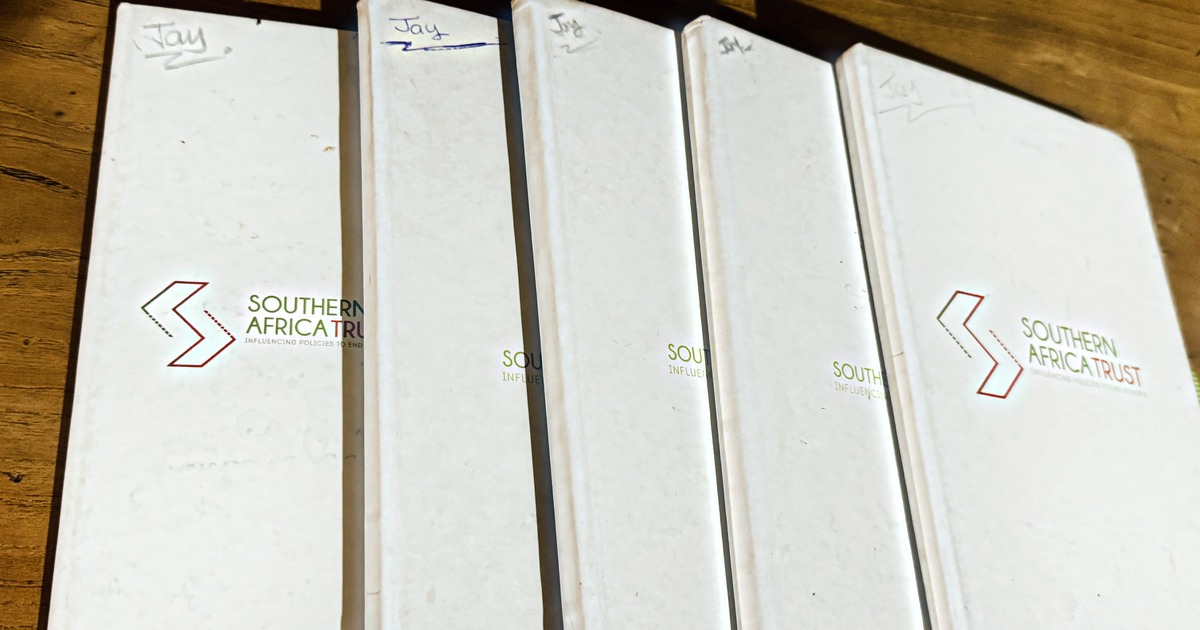
If there’s one thing I’ve learned about leadership, it’s that it takes constant learning, a servant’s posture, and humility. I’ve always lived by writing, every detail of my work, my life, my future, recorded somewhere in a notebook. My bag has always been known to be heavy. A colleague once asked me why, and I pulled out three notebooks I was writing in simultaneously, each holding a different thread of my life.
By the time I left the Trust, I had filled five notebooks. Every page was worth it.
Three Lessons I Am Carrying to AFRODAD
As I step into this new chapter, I carry three lessons, simple ones, but ones I believe every leader can act on. A leader’s legacy is measured by how many other leaders they help bring out of the shadows of “inexperienced”, “unrecognised” and “unfitting”.
Bet on someone. Joy Mabenge took a chance on a CV from a stranger with no full time work experience. That one decision reshaped my entire career. Take the risk. It may be exactly what unlocks the next leader.
Be in the habit of seeing others. Masego did not owe me that message about the Southern Africa Trust opportunity. She sent it because she had made a practice of noticing people and saying their names out loud when opportunities came up. That kind of visibility matters far more than we tend to admit.
Stay a learner, even when entrusted with leadership. You must never grow so big that you forget how little you actually know of what is required of you.
AFRODAD works on the debt question at continental level, which is where the decisions that shape African fiscal space are actually contested. Carrying these lessons into that work is the standard I intend to hold myself to.